

Kopi Confidential: The Ultimate Guide to Order Coffee & Tea in Singapore
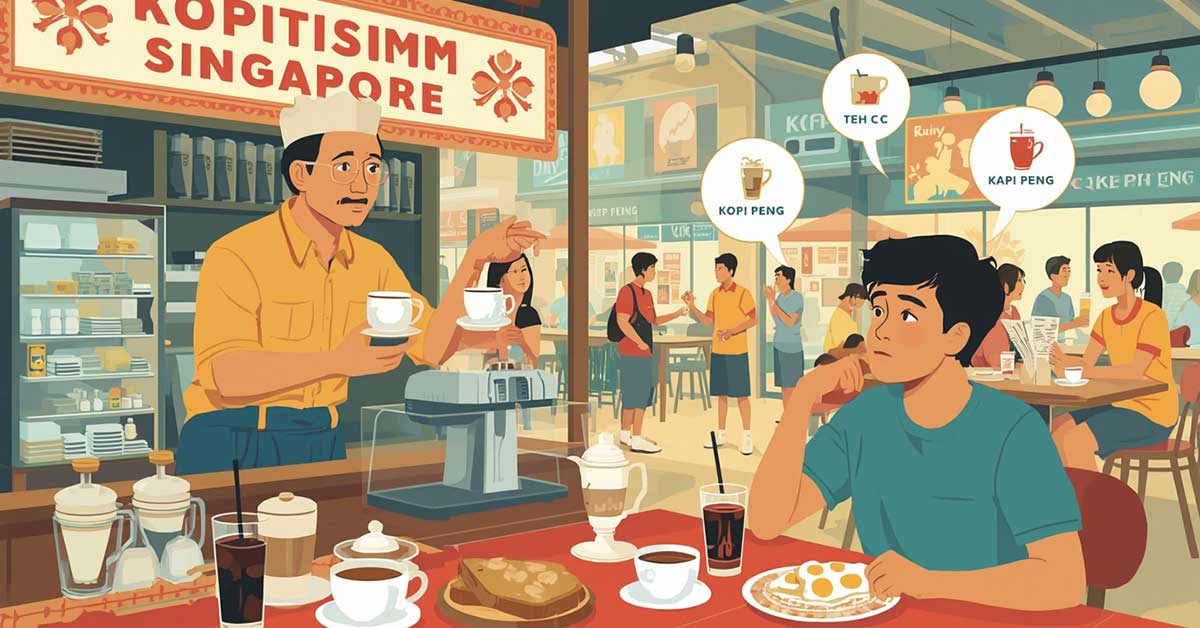
Picture this: it’s 7 in the morning in Singapore. You’ve just stepped into a bustling hawker centre, the air thick with the intoxicating aroma of freshly brewed coffee and toasted bread slathered in kaya (coconut jam). You approach the drinks stall, ready to order a simple cup of coffee. The uncle behind the counter looks at you expectantly. You open your mouth and say, “One coffee, please.” He nods, but before you can add “with milk,” he’s already shouting something in a rapid-fire mix of Hokkien and Malay to his colleague. A minute later, a cup lands in front of you. Is it what you wanted? Maybe. Maybe not.
This scenario plays out countless times every day across Singapore, and it is the shared experience of nearly every foreigner who visits this remarkable island nation. Singapore’s kopi culture is one of the most uniquely fascinating aspects of local life, a rich tapestry woven from the threads of Hainanese, Hokkien, Malay, and English influences. For the uninitiated, the ordering system can seem like a secret code — and in many ways, it is. But once you crack it, you’ll unlock a deeply satisfying and quintessentially Singaporean experience.
This guide is your key to that code. By the end of it, you will know exactly how to walk up to any kopitiam stall in Singapore and order your perfect cup of coffee or tea with the confidence of a born-and-bred local.
What Exactly Is Kopi? A Brief History
The word kopi is derived from the Malay word for coffee, which itself traces its roots to the Dutch koffie. But Singaporean kopi is far more than just a linguistic curiosity — it is a distinct style of coffee with a history as rich as its flavour.
The tradition of the kopitiam (literally “coffee shop” in a blend of Malay and Hokkien) was established in the early 20th century by Hainanese immigrants who arrived in Singapore and set up small coffee stalls to serve the working-class communities of the time. These stalls became the social epicentres of their neighbourhoods, places where labourers, merchants, and families would gather to share news, debate politics, and simply enjoy each other’s company over an affordable cup of coffee.
What makes Singaporean kopi truly unique is the way the coffee beans are prepared. Unlike the light or medium roasts favoured by specialty coffee shops, kopi uses Robusta beans that are wok-roasted in a large wok together with sugar and margarine — and sometimes even corn or wheat. This process caramelises the sugars and coats the beans in a thin layer of fat, resulting in a dark, glossy roast with a distinctive, full-bodied flavour that is simultaneously bitter, sweet, and deeply aromatic. The roasted beans are then ground and brewed by pouring hot water through a flannel “sock” filter — a method that produces a smooth, rich, and intensely flavoured brew that is unlike anything you will find in a Western-style café.
Today, despite the proliferation of international coffee chains and specialty third-wave coffee shops across the island, the humble kopitiam remains a beloved institution. A cup of kopi typically costs between S$1.00 and S$3.60, making it one of the most affordable luxuries in one of the world’s most expensive cities.
The Kopi and Teh Lexicon: Decoding the Secret Language
The genius of the Singaporean coffee ordering system lies in its modularity. Every order is built from a small set of base words and modifiers, and once you understand what each word means, you can construct virtually any combination you desire. The language used is a fascinating creole, drawing primarily from Hokkien dialect but also incorporating Malay and English words.
The two base words are Kopi (coffee) and Teh (tea). Every order starts with one of these two words. Everything else is a modifier that customises your drink. Here is a comprehensive breakdown of the key terms:
| Term | Effect on Your Drink | Meaning |
| Kopi | Base: coffee with condensed milk and sugar | Coffee |
| Teh | Base: tea with condensed milk and sugar | Tea |
| Kopi O / Teh O | No milk added; served with sugar | Coffee / Tea Black |
| Kopi C / Teh C | Uses evaporated (Carnation) milk instead of condensed milk | Coffee / Tea with Evaporated Milk |
| Kopi / Teh Kosong | No sugar added | Zero / Empty |
| Kopi / Teh Siu Dai | Reduced amount of condensed milk or sugar | Less Sweet |
| Kopi / Teh Gah Dai | Extra condensed milk or sugar | More Sweet |
| Kopi / Teh Gao | A stronger, more concentrated brew | Thick / Strong |
| Kopi / Teh Po | A lighter brew with more water | Thin / Weak |
| Kopi / Teh Peng | Served over ice | Cold Drink |
| Pua Siow | Served at a lower temperature, not piping hot | Lukewarm |
| Kopi Gu You | A pat of butter is added to the coffee | Add Butter |
| Teh Tarik | Poured between cups to create a frothy top | Pulled Tea |
| Kopi Di Lo | Coffee with no water added at all; pure concentrate | Extra Thick |
The beauty of this system is that these modifiers can be combined. A “Kopi C Siu Dai Peng” is an iced coffee made with evaporated milk and less sugar. A “Teh O Kosong Gao” is a strong, black tea with absolutely no sugar. The combinations are nearly endless, and the kopitiam uncle has almost certainly heard them all.
One particularly beloved order is Teh Tarik, which is the art of “pulling” the tea — pouring it in a long, dramatic arc between two cups to aerate the liquid and create a thick, frothy top. It is a performance as much as a preparation method, and watching a skilled kopitiam uncle execute a perfect tarik is a sight to behold.
Beyond Kopi and Teh: Other Kopitiam Classics
No visit to a kopitiam is complete without exploring some of the other unique drinks on offer. The local drink stall is a treasure trove of Singaporean culinary creativity, and some of the most beloved orders have wonderfully colourful names.
| Term | Meaning |
| Milo Dinosaur | Iced Milo (chocolate malt drink) topped with a generous heap of undissolved Milo powder |
| Milo Godzilla | Milo Dinosaur with an additional scoop of ice cream |
| Michael Jackson | A black-and-white drink made from grass jelly (cincau) and fresh soya milk |
| Tak Giu | Hokkien slang for Milo (literally “kick ball,” a reference to the brand’s sports sponsorships) |
| Diao Yu | Chinese tea (literally “fishing,” as the tea leaves are left to steep like a fishing line) |
| Bandung | A sweet, rose-flavoured drink made with evaporated milk and rose syrup |
Building Your Perfect Kopi: A Component-Based Guide
To make the ordering process even clearer, think of it as building your drink from a set of modular components. You simply pick one option from each category and string them together in a logical order. This method allows you to construct any drink you can imagine.
Here is the breakdown of the components:
Component 1: The Base (Choose 1)
This is the foundation of your drink.
| Term | Meaning |
| Kopi | Coffee |
| Teh | Tea |
Component 2: The Milk (Choose 1, or skip for default)
| Term | Meaning |
| (Default) | Condensed Milk |
| O | No Milk |
| C | Evaporated Milk |
Component 3: The Sweetness (Choose 1, or skip for default)
This controls the sugar level. The default is standard sweetness.
| Term | Meaning |
| (Default) | Standard Sweetness |
| Siu Dai | Less Sweet |
| Gah Dai | More Sweet |
| Kosong | No Sugar |
Component 4: The Strength (Choose 1, or skip for default)
This adjusts the intensity of the coffee or tea flavour.
| Term | Meaning |
| Gao | Stronger |
| Po | Weaker |
Component 5: The Temperature (Choose 1, or skip for default)
| Term | Meaning |
| (Default) | Hot |
| Peng | Iced |
| Pua Siow | Lukewarm |
Putting the Components Together: Examples
Now, let’s use the component builder to create some orders:
Example 1: Iced black coffee with no sugar.
•Component 1 (Base): Kopi
•Component 2 (Milk): O (No Milk)
•Component 3 (Sweetness): Kosong (No Sugar)
•Component 4 (Strength): (skipped)
•Component 5 (Temperature): Peng (Iced)
Your Order: Kopi O Kosong Peng
Example 2: Hot tea with evaporated milk and less sugar.
•Component 1 (Base): Teh
•Component 2 (Milk): C (Evaporated Milk)
•Component 3 (Sweetness): Siu Dai (Less Sweet)
•Component 4 (Strength): (skipped)
•Component 5 (Temperature): (skipped, defaults to hot)
Your Order: Teh C Siu Dai
Example 3: A strong, standard hot coffee.
•Component 1 (Base): Kopi
•Component 2 (Milk): (skipped, defaults to condensed milk)
•Component 3 (Sweetness): (skipped, defaults to standard sweet)
•Component 4 (Strength): Gao (Stronger)
•Component 5 (Temperature): (skipped, defaults to hot)
Your Order: Kopi Gao
This modular approach is the secret to the kopitiam ordering system. Once you understand the components, you can mix and match them to create your perfect, personalized beverage every single time.
Pro Tips for the First-Time Kopitiam Visitor
Beyond the language, there are a few unwritten rules and practical tips that will make your kopitiam experience smoother and more enjoyable.
Takeaway orders are served in plastic bags or paper cup. This is perhaps the most surprising thing for foreigners. If you say “ta bao” (Hokkien/Mandarin for “takeaway”), your drink will be poured into a thin plastic bag with a rubber band tied around a straw or paper cup. It sounds precarious, but it is an art form that Singaporeans have perfected over generations. The bag is surprisingly sturdy and keeps your drink cold for longer than a cup.
Pay at the stall, not at a central cashier. Unlike in a restaurant, you pay each individual stall separately. Walk up, order, pay, and collect your drink. There is no table service at a traditional kopitiam.
Prices are fixed and affordable. A standard cup of kopi or teh costs between S$1.00 and S$2.40. Iced versions are slightly more expensive. Do not expect to negotiate the price.
The best time to visit is early morning. The kopitiam is at its most vibrant between 6am and 9am, when the coffee is freshest and the atmosphere is most alive. Many stalls close or slow down significantly by mid-morning. Locals also like to have a relaxing coffee break after lunch.
Pair your kopi with kaya toast. The classic Singaporean breakfast pairing of kopi and kaya toast (with soft-boiled eggs on the side) is a national institution. The richness of the toast perfectly complements the bold flavour of the coffee.
Where to Get the Best Kopi in Singapore
In Singapore, you don’t have to search far to find a good cup of kopi. You can get it almost anywhere there is a coffee shop, hawker centre, or neighbourhood kopitiam. From large food centres to small corner coffee stalls in residential estates, kopi is a daily staple for many locals.
That said, a few establishments have become legendary for the quality and tradition of their brew.
Ya Kun Kaya Toast / Toast Box is perhaps the most famous kopi chain in Singapore, with outlets across the island and even internationally. Their kopi is consistently excellent, and their kaya toast set is widely considered the classic Singaporean breakfast experience.
Heap Seng Leong on North Bridge Road is a favourite among kopi purists. It is known for its exceptionally strong and aromatic brew prepared using traditional methods, including the iconic butter kopi.
For the most authentic experience, however, simply walk into any neighbourhood kopitiam in a residential area, away from the tourist trail. The coffee will be honest, the prices will be affordable, and the atmosphere will be genuinely local.
Conclusion: More Than Just a Cup of Coffee
Ordering kopi in Singapore is not merely a transactional act — it is a cultural ritual, a small but meaningful way of connecting with the soul of a city that takes immense pride in its food and drink heritage. When you stand at a kopitiam counter and confidently order a “Kopi C Siu Dai Peng,” you are participating in a tradition that stretches back over a century, one that has survived the rise of global coffee chains and the relentless march of modernisation.
So the next time you find yourself in Singapore, skip the international coffee chain and head to your nearest kopitiam. Armed with the knowledge in this guide, you are more than ready to order your perfect cup. The uncle behind the counter might even give you an approving nod — and in Singapore, that is the highest compliment you can receive.