
⚡ Key Takeaways
- ✓A travel itinerary poster combines both planning information and visual storytelling, making travel plans easy to understand and engaging.
- ✓Starting with a clear theme, destination, and structure helps guide both the content and design of the poster.
- ✓Using AI tools speeds up the creation process by generating layouts, visuals, and content quickly.
- ✓Simple, clean design with a strong focal point and minimal text improves readability and visual impact.
- ✓Adding key details like dates, locations, and highlights ensures the poster is both informative and visually appealing.
Turn Your Travel Itinerary Into a Fun Illustrated Poster: Beginner’s Guide for Singaporean Travelers
Planning a holiday is exciting, but creating a day by day itinerary can quickly become overwhelming. Long lists of places to visit, meals to try, and activities to fit in can make your planning feel like a chore.
What if there was a way to turn your travel itinerary into something fun and visually appealing? That’s where a travel itinerary poster comes in. Instead of staring at endless text, you can create a beautiful, illustrated poster featuring cute icons, chibi traveler characters, and colorful visuals that make your trip feel alive even before you leave.
Whether you’re exploring Singapore, Southeast Asia, or anywhere in the world, this beginner-friendly guide will show you how to create a travel itinerary poster, step by step, while keeping it fun, easy to follow, and highly shareable.
Why Use a Travel Itinerary Poster?
A travel itinerary poster is more than just a visual aid. It’s a way to:
- Make planning enjoyable: Turning lists into a poster brings creativity and fun.
- Visualize your trip: See all activities, meals, and attractions at a glance.
- Share easily: Post it on social media or send it to friends and family.
- Keep as a memory: Your poster doubles as a keepsake of your adventure.
For beginners, it’s especially helpful because it simplifies complex plans into a digestible, visual format.
Step by Step Guide: How to Create Your Travel Itinerary Poster
Creating a travel itinerary poster is easier than you think. Follow these five steps and you will have a beautiful, shareable poster ready before your trip.
Step 1: Generate Your Travel Itinerary Using AI
Before you design anything, you need a solid trip plan. This is where AI tools like ChatGPT or Claude come in handy. Simply tell the AI your destination, how many days you are travelling, and what you enjoy food tours, history, nature, shopping and it will generate a detailed day-by-day schedule for you.
For example, if you are planning a 3-day trip to Penang, your AI-generated plan might look like: Day 1 George Town street art walk, char koay teow for lunch, Khoo Kongsi at sunset.
Step 2: Now we will generate the main poster using this structure
- The Core Prompt of the poster(Overall Concept)
- The Top Header Section
- The Main Body: The Day Panels (Repeat Elements)
- Decorative Details & Borders
- Bottom Footer Section
- Specific Day Examples (Singapore Version)
The Core Prompt of the poster(Overall Concept)
This section defines the basic style, composition, and mood.
Prompt:
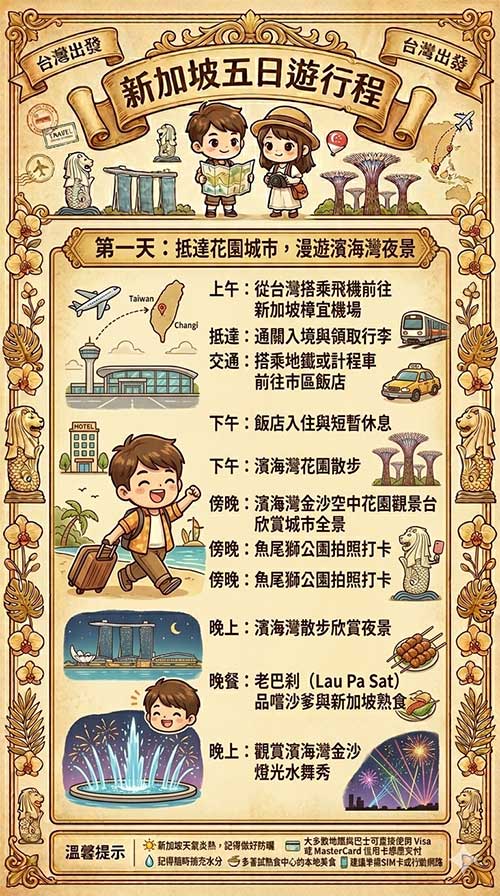
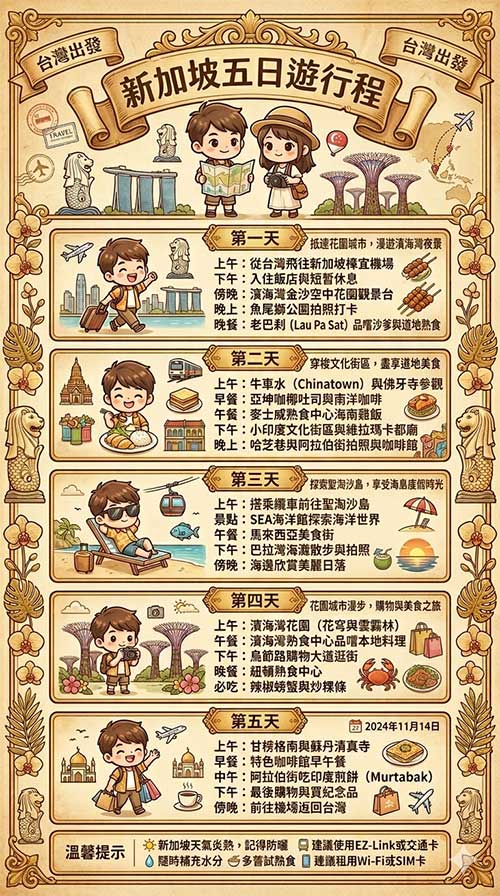
A detailed and organized Singapore travel itinerary poster illustration with a vintage-ornate, slightly aged paper texture and a golden sepia-tone color palette. The art style is cute chibi character animation. The composition is a vertically stacked layout of distinct, ornate panels, contained within an elaborate, symmetrical decorative border. The design resembles a collectible illustrated travel guide poster with lively characters and miniature landmark icons.
The Top Header Section
This section describes the title, the top characters, and the small map.
Prompt
The top header panel is a large ornate scroll banner. Large stylized characters on it read:「新加坡5日遊行程」 (Singapore 5-Day Trip Itinerary)
Smaller banners in the top corners state:
「台灣出發」 (Departs from Taiwan)
「2026」Below the central banner, two central chibi travelers (the main recurring character) stand holding a map and suitcase, surrounded by small landmark icons of the Merlion statue, Marina Bay Sands, and the Supertree Grove at Gardens by the Bay.
A small stylized flight path map from Taiwan to Singapore appears in the top-right corner with a tiny airplane icon.
The Main Body: The Day Panels (Repeat Elements)
This is the most complex section. It is crucial to define the structure of a generic day panel and then detail the contents. Repeat this step as many times as needed, depending on the number of days.
Prompt (Continued):
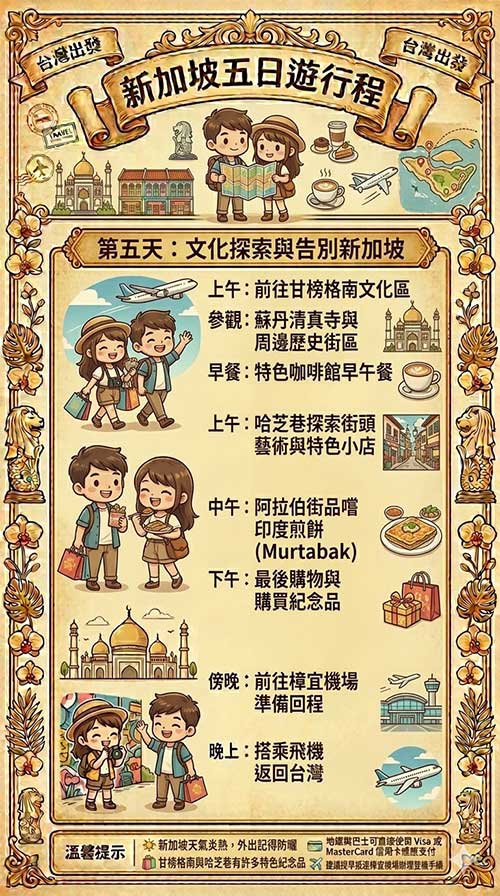
The main body consists of five vertically stacked rectangular panels, labeled Day 1 through Day 5.Each panel is structured as follows:
Header
A smaller ornate gilded banner stating the day (e.g., 「DAY 1」) and a central location or movement icon (such as an airplane, MRT train, or walking arrow). The text on this banner is in Traditional Chinese.
Character (Recurring)A unique active pose of the same chibi traveler character appears in each panel, interacting with the environment.
Examples include:
Relaxing at the beach
Taking photos with landmarks
Eating hawker food
Riding the MRT
Shopping with bagsDate
A small distinct date icon is placed in each panel.
Example format: 「2026年11月10日」The List
Bulleted or numbered itinerary items written in Traditional Chinese describing activities and food locations.
Example format:
- 上午:抵達新加坡樟宜機場
- 下午:魚尾獅公園拍照
- 晚上:老巴剎夜市吃沙爹
Icons
Small matching icons appear beside each list item.
Examples include:
- airplane icon
- Merlion icon
- hawker food plate
- chili crab
- MRT train
- beach umbrella
- shopping bag
All icons match the cute chibi illustration style.
Decorative Details & Borders
This creates the framing and the unique warm vintage aesthetic.
Prompt (Continued):
The entire vertical poster composition is framed by a heavy ornate gilded golden border.The border is symmetrically decorated with small Merlion statues, orchid flowers (Singapore’s national flower), tropical leaves, and decorative lanterns.
Subtle elements like tiny airplane icons and travel stamps are embedded in the border design.
The overall texture resembles aged parchment paper with warm sepia tones, giving the poster a nostalgic travel-journal feeling.
Bottom Footer Section
The final section provides travel tips.
Prompt (Continued):
At the bottom, a dedicated horizontal panel is labeled with a clipboard icon and the Traditional Chinese text:「溫馨提示」 (Useful Tips)
It contains a bulleted list of helpful travel advice with matching icons:
- ☀️ 防曬用品(新加坡天氣炎熱)
- 🚇 建議購買EZ-Link卡或旅遊交通卡
- 💧 多補充水分
- 🍜 多嘗試熟食中心的本地美食
- 📱 租用Wi-Fi或SIM卡保持網路
The layout is clean, balanced, and visually easy to read.
Specific Day Examples (Singapore Version)
Last Prompt (Continued):
Day 1: Arrival in Singapore, Marina Bay Sands, Merlion Park, Lau Pa Sat hawker food icons.
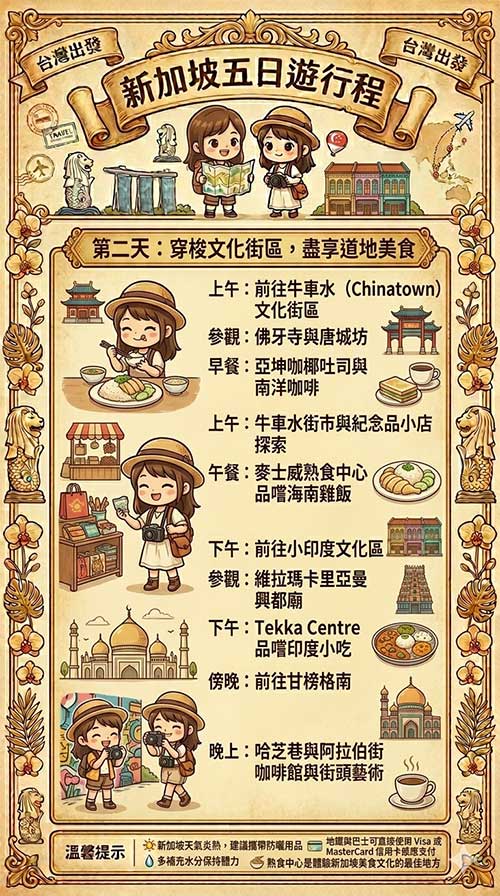
Day 2: Chinatown, Maxwell Food Centre, Little India, Haji Lane street art icons.
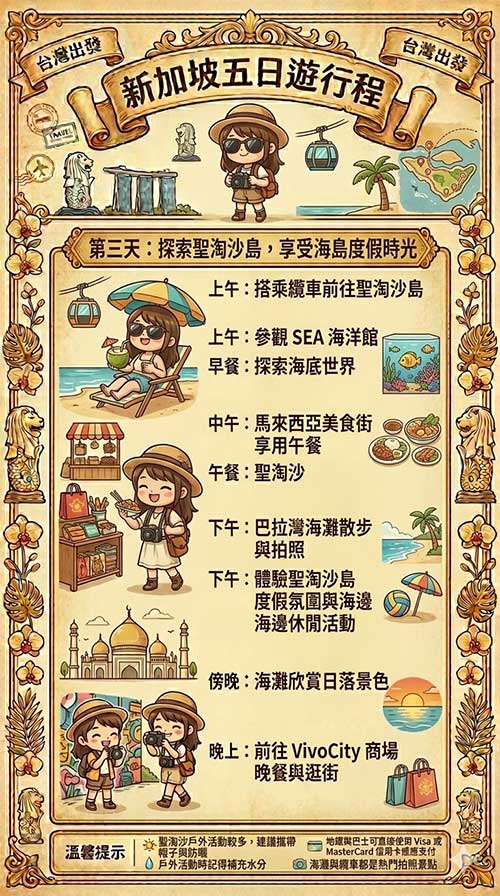
Day 3: Sentosa Island, beach umbrellas, cable car, SEA Aquarium icons.
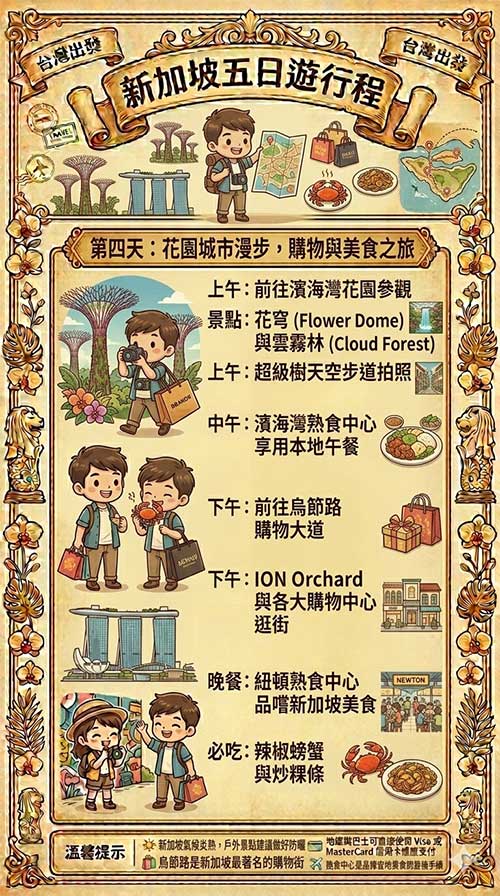
Day 4: Gardens by the Bay Supertrees, Orchard Road shopping, chili crab and hawker icons.
Day 5: Kampong Glam, Sultan Mosque, café breakfast, souvenir shopping, airplane departure icon.
Tips & Best Practices
- Keep it simple: Avoid cluttering each day with too many icons.
- Consistent characters: Use the same chibi traveler style for continuity.
- Highlight must-see spots: Use bigger icons or banners for signature landmarks.
- Add personal touches: Photos or sketches can make your poster unique.
- Share on social media: Instagram, TikTok, Threads, Xiaohongshu, or Facebook.
Ready to Start Designing?
Creating a travel itinerary poster is one of the most enjoyable ways to prepare for any trip. It combines the practical side of planning figuring out where to go and what to eat with the creative joy of making something beautiful.
With free AI tools to generate your schedule and beginner-friendly design platforms, there has never been a better time to try this for yourself. Whether you are heading to Bali next month or dreaming about a future trip to Europe, your travel itinerary poster can start taking shape today.
Start building your first travel itinerary poster. Your future self scrolling through holiday memories will thank you for it.
FAQ Section
What exactly is a travel itinerary poster?
A travel itinerary poster is an illustrated, visual layout of your trip plan. It organises your daily activities, meals, landmarks, and travel tips into a poster format using icons, drawings, and colour, making your itinerary much easier and more enjoyable to read at a glance.
Do I need design skills to make one?
Not at all. Beginner friendly tools like Canva come with pre-built travel poster templates that you can simply customise with your own text and icons. You do not need any formal design training to create something that looks polished and professional.
How do I generate a good itinerary to start with?
AI tools like ChatGPT or Claude are excellent for this. Tell them your destination, trip length, budget, and interests. They will generate a detailed, day by day schedule that you can tweak to suit your preferences before turning it into a poster.
Can I use this method for international trips, not just Singapore?
Absolutely. The travel itinerary poster method works for any destination in the world. Simply swap the icons and landmarks to match your location sushi icons for Tokyo, Eiffel Tower doodles for Paris, or gondola illustrations for Venice.
What are the best tools to create a travel itinerary poster?
For itinerary generation, try ChatGPT or Claude. For designing the poster itself, Canva is the most beginner-friendly and has free templates. If you want more creative control, Figma or Adobe Illustrator are great options for intermediate to advanced users.
Can I print my travel itinerary poster?
Yes! Export your design as a high resolution PNG or PDF, then print it at home, at a photo printing shop, or through an online service. A printed travel itinerary poster makes a wonderful travel journal keepsake or even a gift for a fellow traveller.
Use the same structure for each individual day poster, but there is no need to repeat the Main Body.