
If you’ve ever typed “Ice Kacang” into an AI image generator and received something generic, flat, or completely off-culture and not totally what you are looking for — you’re not alone.
The quality of your AI image depends almost entirely on the quality of your prompt. Feed them something lazy, and they’ll hand you something generic. Feed them something rich and specific, and suddenly you’ve got images that make people stop mid-scroll.
If you want beautiful, authentic, scroll-stopping local dessert images — you need to describe them like a food photographer, a chef, and a cultural storyteller combined.
In this guide, I’ll show you exactly how to craft prompts that generate stunning local dessert visuals — whether for blogs, social media, menus, or marketing.
Step 1: Be Specific About the Dessert
This is where most people trip up right at the start. They type the dessert name and assume the AI will fill in the blanks. Sometimes it does. More often, it doesn’t — especially when we’re talking about hyper-local desserts that aren’t exactly mainstream on the internet.
Your job is to leave nothing to assumption.
Don’t say:
“Generate a local dessert.”
Say:
“Generate a bowl of traditional chendol with shaved ice, gula melaka syrup, coconut milk, and red beans.”
The AI cannot “guess” what local means to you. Local in Singapore is different from local in Thailand or France.
Notice the details:
- Green pandan jelly
- Thick palm sugar syrup
- Crushed ice
- Coconut milk drizzle
These are details you must include in your prompt.
Step 2: Describe Ingredients Like a Food Stylist
Once you’ve named your dessert, go deeper into the ingredients. Think about how a food stylist would look at the dish before a shoot — they notice every colour, every layer, every way light catches a glossy surface.
Instead of:
“Sweet potato soup”
Write:
“A traditional Asian sweet potato soup served in a porcelain bowl, orange sweet potato chunks in light ginger syrup, slight steam rising, warm dessert.”
The more visual you are, the more realistic your result.
Think in layers:
- Color (golden brown syrup, emerald green jelly)
- Texture (glossy, creamy, crushed ice, soft tofu)
- Shape (cubed, shaved, shredded)
- Temperature (steaming hot, chilled with condensation)
Step 3 — Put Your Dessert Somewhere Real
This is the step that separates a pretty food image from one that actually *means* something — and it’s the step that most people completely skip.
Local desserts aren’t born in photography studios. They come from hawker stalls with plastic stools, from pasar malam carts with bare bulbs swinging overhead, from kopitiam counters with old ceramic tiles and hand-written menus. That context is part of what makes them special.
Instead of just describing the dessert, add:
- Served at a hawker center
- Plastic bowl and spoon
- Slightly melted syrup
- Natural lighting
- Humid tropical vibe
- at a traditional Malay kuih stall, banana leaf lining the tray
- on a worn wooden table at a morning kopitiam
- at a pasar malam cart, warm tungsten bulb overhead, slight blur of a crowd behind
- served on rattan with fresh pandan leaves and halved coconut nearby
Prompt example:
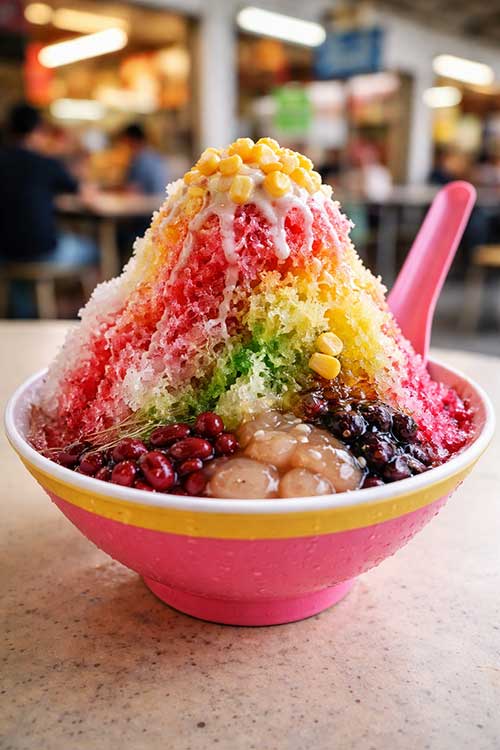
A vibrant bowl of ice kachang at a Singapore hawker center, colorful syrup over finely shaved ice, red beans and attap chee inside, served in a plastic bowl under natural daylight, slight condensation, documentary food photography style.
Step 4: Control the Photography Style
Here’s something that completely changes your results once you discover it: AI image generators respond to photography direction the same way a real photographer would. You can control the angle, the lens style, the lighting, and the overall mood — just by adding the right words.
Some of the most effective photography directions for food content:
- macro photography — pulls you in close, great for textures and detail shots
- top-down flat lay — clean and organised, works beautifully for styled kuih arrangements
- 45-degree angle, shallow depth of field — the classic food blog shot, blurred background, sharp foreground
- documentary food photography — candid, atmospheric, feels like the real thing
- high-end food magazine style — polished, editorial, professional
- cinematic lighting, warm tones — dramatic and moody, great for rich desserts like black glutinous rice
For example:
Close-up macro food photography of traditional ondeh ondeh, coated in grated coconut, pandan green glutinous rice balls, one cut open showing molten gula melaka center, soft diffused lighting, shallow depth of field.
Step 5: Use This Proven Prompt Structure
Here’s a simple framework you can reuse:
[Dessert Name] + [Key Ingredients] + [Serving Context] + [Photography Style] + [Lighting] + [Mood]
Example:
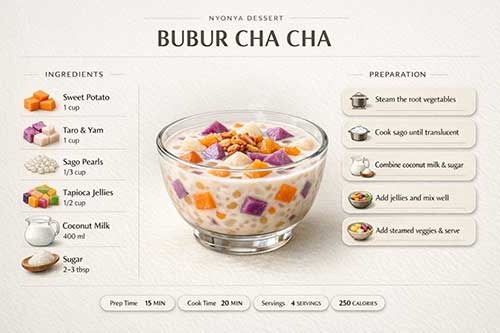
Traditional bubur cha cha with diced sweet potatoes, taro cubes, sago pearls in coconut milk broth, served in a ceramic bowl at a local hawker stall, warm natural light, realistic food photography, high detail, shallow depth of field.
This structure works across most AI image platforms.
Mistakes That Are Quietly Killing Your Results
Before you go generate, here are the most common habits that trip people up:
- Writing too short. A three-word prompt is a three-word result. You don’t have to write an essay, but you do need to give the AI enough to work with.
- Skipping the ingredients. The AI can’t render what it doesn’t know is there. If your dessert has a specific filling, syrup, or topping — say it.
- Forgetting the environment. A white background is fine for a product shot. But for local food content? The setting is half the story.
- Leaving out lighting. Lighting changes everything in food photography, and it changes everything in AI generation too. Even adding “soft natural light” or “warm tungsten glow” makes a noticeable difference.
- Stacking conflicting styles. Prompts like “hyperrealistic anime cinematic watercolour oil painting photo” confuse the AI and muddy the output. Pick one visual direction and own it.
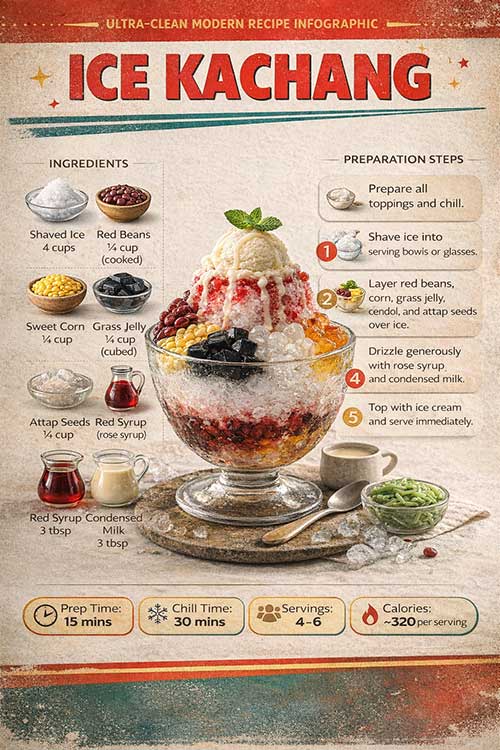
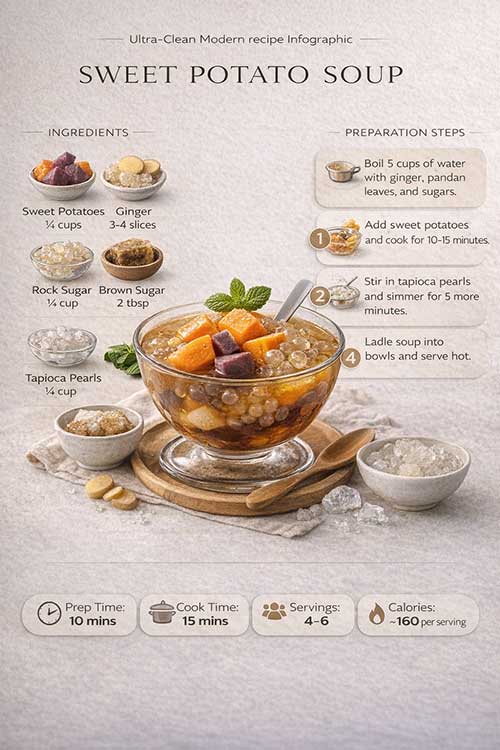
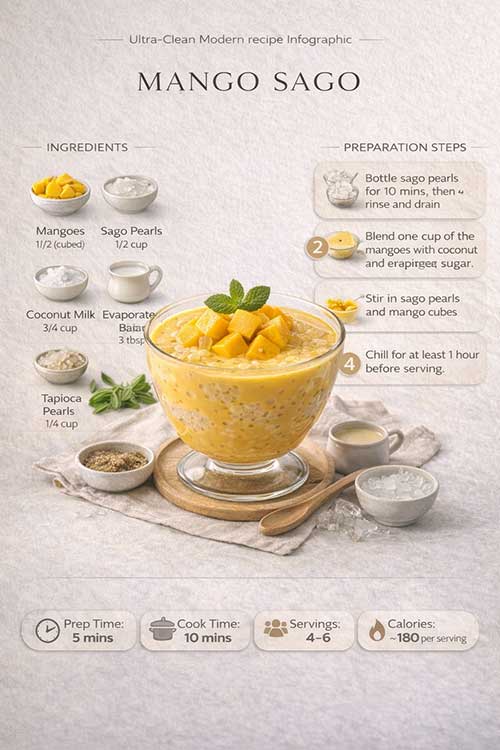
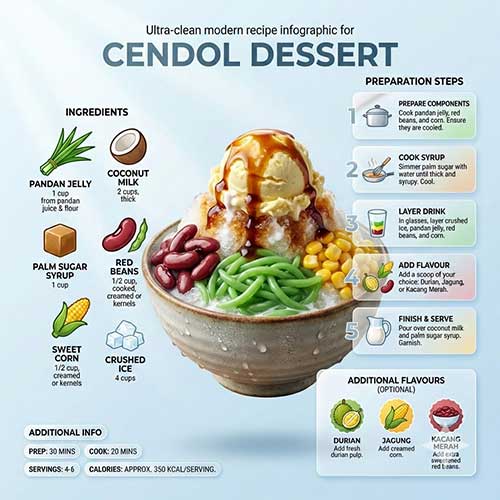
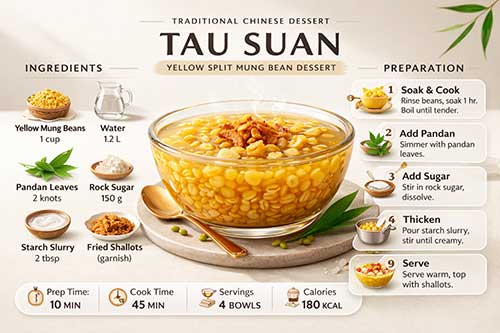
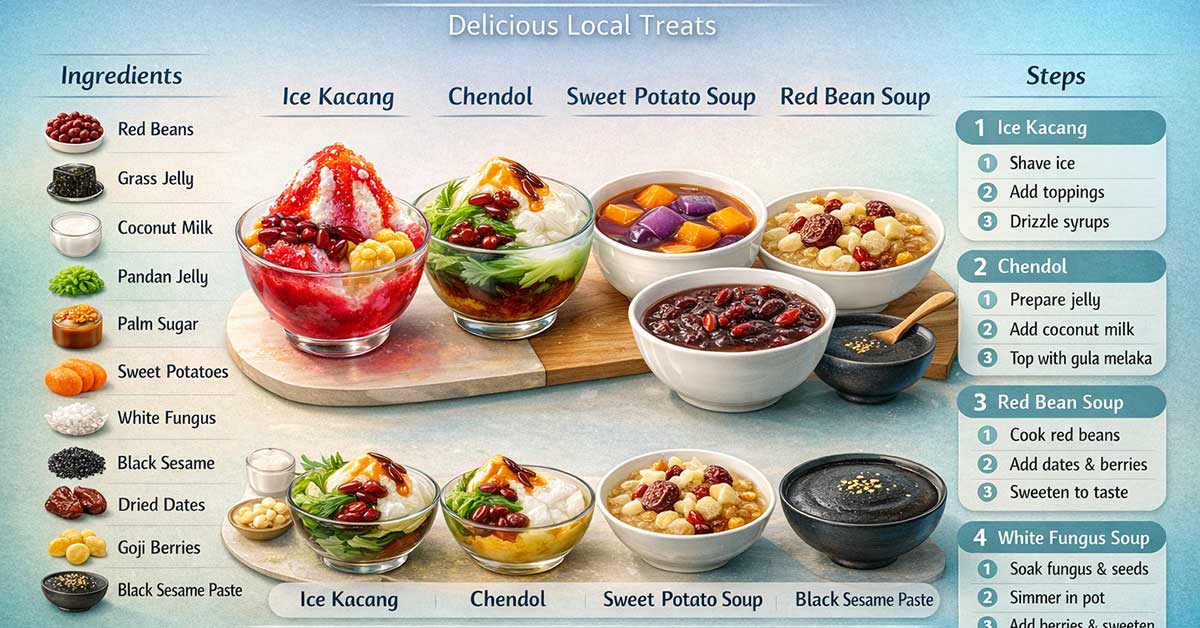
Bonus: Since you’ve read this far, here’s a ready-made structured layout you can use when generating dessert images. It’s perfect for lazy people who want consistent, cookbook-style infographic visuals and automatically shows the ingredients used, so your audience can instantly see what goes into the dessert without extra effort.
This is my prompt strucutre:
[Style / Theme]
Ultra-clean modern recipe infographic for [DESSERT NAME].
[Hero Image / Centerpiece]
Centered photorealistic 3D render of a glass dessert bowl filled with detailed ingredients, realistic textures, glossy glass reflections, soft studio lighting, subtle shadows, high detail, vibrant but natural food colors.
[Background]
Light pastel gradient background (soft blue to teal), minimalistic design, spacious layout.
[Left Section / Ingredients Panel]
Left side: ingredients section with small realistic ingredient icons, clean grid layout, ingredient name and measurement underneath each icon.
[Right Section / Preparation Steps Panel]
Right side: preparation steps displayed in rounded soft UI cards, numbered steps with small matching icons, short clear instructions.
[Top Section / Header]
Top: small subtitle line and large bold uppercase title.
[Bottom Section / Additional Info]
Bottom: additional info section with pill-shaped tags (prep time, cook time, servings, calories).
[Typography & Layout Details]
Modern sans-serif typography, professional cookbook layout, high-resolution, commercial food magazine style, balanced composition, soft glow highlights.
Conclusion
Writing AI prompts for local dessert images has nothing to do with being a tech person. It has everything to do with being a food person — someone who notices details, understands cultural context, and knows how to tell a story through the way something looks.
The best prompt you’ll ever write isn’t the most complicated one. It’s the most vivid one. The one that reads like you’re describing a memory, not filling out a form.
When you get that right, you won’t just generate an image of a dessert.
You’ll generate a craving.
Now go make something delicious. 🍡
Sample of the image generated